Permutation Betting in Horse Racing: How Perms Work and What They Cost
 Available in US
The first Placepot I played with any seriousness had 48 lines. I remember the number because I had worked it out on the back of a racecard, multiplying selections across six legs and feeling rather clever about my coverage. Six months later, I was down to 8-line perms and getting better results. The lesson was not about luck – it was about understanding that permutation costs and permutation value are not the same thing, and that more lines do not automatically mean a better chance of profit.
How Permutation Betting Multiplies Your Lines
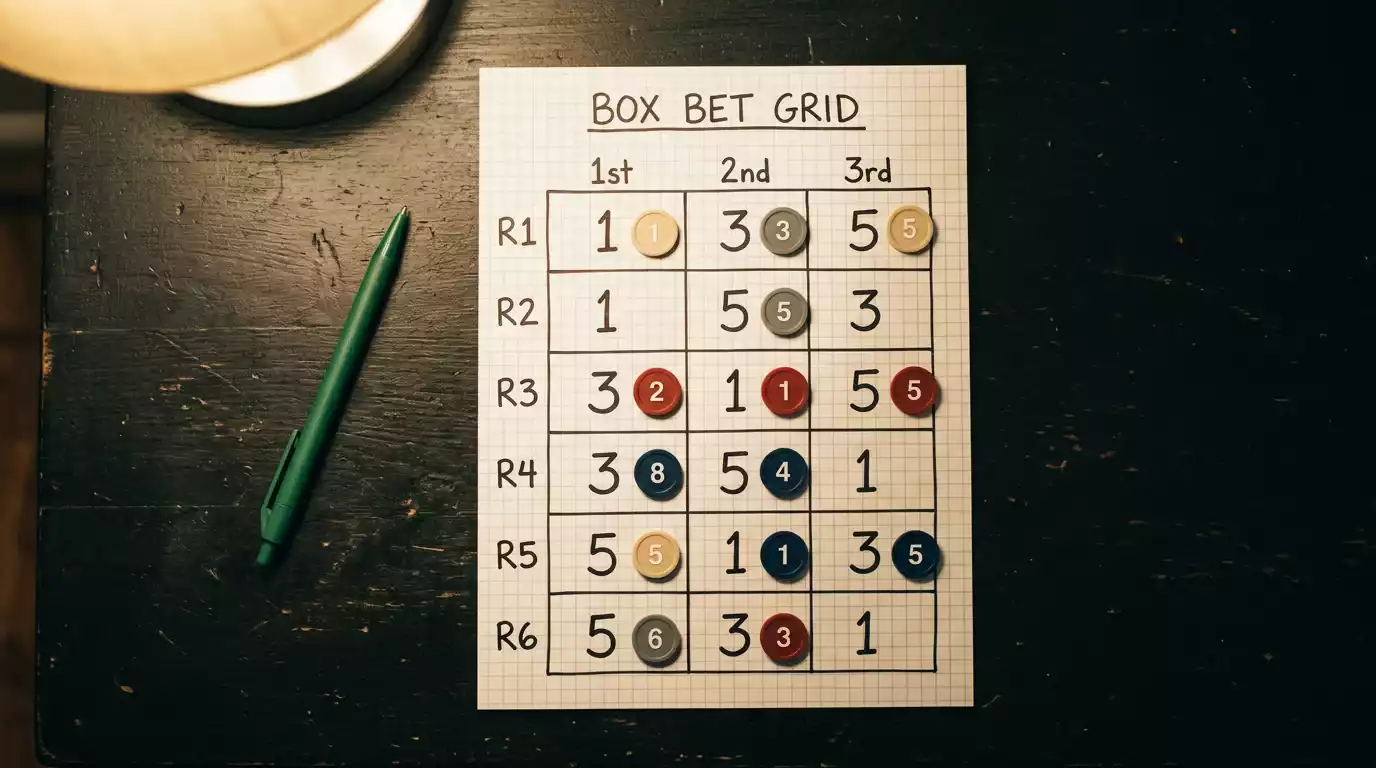
A permutation – “perm” in racing shorthand – is the total number of combinations generated by your selections across multiple legs or positions. The calculation is pure multiplication. If you select two horses in leg one and three in leg two, you have 2 x 3 = 6 permutations. Each perm is a separate line, and each line costs one unit stake.
In a Placepot with six legs, the multiplication runs across all six. One selection per leg = 1 x 1 x 1 x 1 x 1 x 1 = 1 line. Two per leg = 2 x 2 x 2 x 2 x 2 x 2 = 64 lines. Three per leg = 729 lines. The escalation is exponential in feel, even though mathematically it is polynomial. Adding a single extra selection to one leg multiplies your entire perm by one additional factor – and in a six-leg product, that factor compounds quickly.
The same principle applies to any multi-leg pool bet: Scoop6, Jackpot, Pick 3, Pick 4, Daily Double. The number of legs and the number of selections per leg determine the total perm, and the total perm multiplied by the unit stake is your total cost. There is no discount for volume. One hundred lines at £2 costs £200, full stop.
Calculating Perm Costs for Placepot, Scoop6 and Multi-Race Bets
The average Placepot dividend is around £407, which gives you a benchmark against which to judge your perm cost. If your Placepot perm costs £100, you need the dividend to exceed £100 just to break even – and the average is £407 but the median is lower, because a few very large dividends pull the average up. Knowing your breakeven point before you place the bet is essential.
Here is how I calculate a typical Festival Placepot perm. Suppose my structure across six legs is: 1, 2, 1, 3, 2, 1 selections. The total is 1 x 2 x 1 x 3 x 2 x 1 = 12 lines. At £2 per line, the cost is £24. If I add one more selection to the third leg (changing it from 1 to 2), the new total is 1 x 2 x 2 x 3 x 2 x 1 = 24 lines = £48. That single extra horse in one leg doubled my total cost. This is the multiplication trap that catches beginners.
For the Scoop6, the dynamics are identical but with a £2 minimum stake. A conservative Scoop6 perm – three banker legs and three spread legs with two selections each – costs 1 x 1 x 1 x 2 x 2 x 2 = 8 lines = £16. A more aggressive perm with two selections in five legs and three in one: 2 x 2 x 2 x 2 x 2 x 3 = 96 lines = £192. The spread from conservative to aggressive is enormous, and the question is always whether the extra coverage justifies the extra cost.
Banker Perms: Reducing Lines by Fixing One Selection
A banker leg is a race where you use a single selection – one horse, one contribution to the multiplication. Every banker leg keeps the perm count flat at that stage, acting as a multiplier of 1. The more banker legs you use, the lower your total perm, and the lower your cost.
The skill is in identifying which legs deserve banker status. I look for races with a short-priced favourite that has a strong place record, or a horse returning to conditions where it has performed consistently. National Hunt races with proven course-and-distance winners are natural banker candidates for the Placepot, because the place requirement – not win – gives the horse an extra cushion. A horse priced at 4/5 to win is effectively much shorter to place, and using it as a banker saves you from adding a second or third selection in that leg.
The Kev Matthews approach – a small stake generating a life-changing return – depends fundamentally on banker discipline. A £1 Placepot with 4 lines has a much better return-on-investment profile than a £1 Placepot with 64 lines, assuming both hit the dividend. The 64-line perm gives you more chances of surviving, but the 4-line perm costs £4 versus £64. If the dividend is £1,000, the 4-line player nets £996 from a £4 outlay. The 64-line player nets £936 from a £64 outlay. Both are profitable, but the cost-per-unit return is dramatically different.
The Over-Perm Trap: When Coverage Costs More Than It Adds
Over-perming is the single most expensive habit in exotic pool betting. I know because I did it for three years before the data forced me to stop. The temptation is always the same: “one more horse in that tricky leg, just to be safe.” But each additional selection multiplies the entire perm, and the marginal value of that extra selection is almost always less than its marginal cost.
Consider a Placepot where you have five legs sorted and one leg that looks wide open. You are torn between two horses and four horses for that leg. With two selections, your perm might be 16 lines = £32. With four selections, it jumps to 32 lines = £64. The two extra horses in that leg cost you an additional £32 – the same as your entire perm without them. For that £32 to be justified, those two extra horses need to provide a meaningful increase in your probability of surviving that leg. If the two horses you are adding are 20/1 and 33/1 shots with thin place form, the probability increase is marginal. The £32 is better spent on a separate Placepot entry with a different structure than on covering longshots in a single leg.
My rule: never more than three selections in any single Placepot or Scoop6 leg. If I cannot narrow a race to three, I use the market leader as my default and accept the risk. The discipline pays off across a season – tighter perms, lower costs, and a higher return-on-investment when dividends land.
For a complete guide to the Placepot product where these permutation principles apply most directly, see the Placepot betting guide.
How do you calculate the total number of Placepot perms with mixed selections?
Multiply the number of selections in each leg together. For example, a Placepot with selections of 1, 2, 1, 3, 2, 1 across the six legs produces 1 x 2 x 1 x 3 x 2 x 1 = 12 permutations. Each permutation costs one unit stake, so 12 perms at £1 = £12 total.
What does it mean to perm a Scoop6 with two selections in each leg?
Selecting two horses in each of the six Scoop6 legs generates 2 x 2 x 2 x 2 x 2 x 2 = 64 permutations. At the £2 minimum unit stake, the total cost is £128. Each permutation represents a different combination of one horse from each leg, covering all possible pairings of your selections.
Is it ever worth having more than four selections in a single Placepot leg?
Rarely. Each additional selection multiplies your entire perm cost, and the marginal probability gain from a fifth or sixth selection in one leg is typically small relative to the cost increase. Keeping all legs to three selections or fewer maintains a manageable perm size and preserves return-on-investment when the dividend lands.
Published by the Exotic Bets Horse Racing team.