
Forecast vs Exacta: How UK Fixed-Odds and Pool Payouts Compare
 Available in US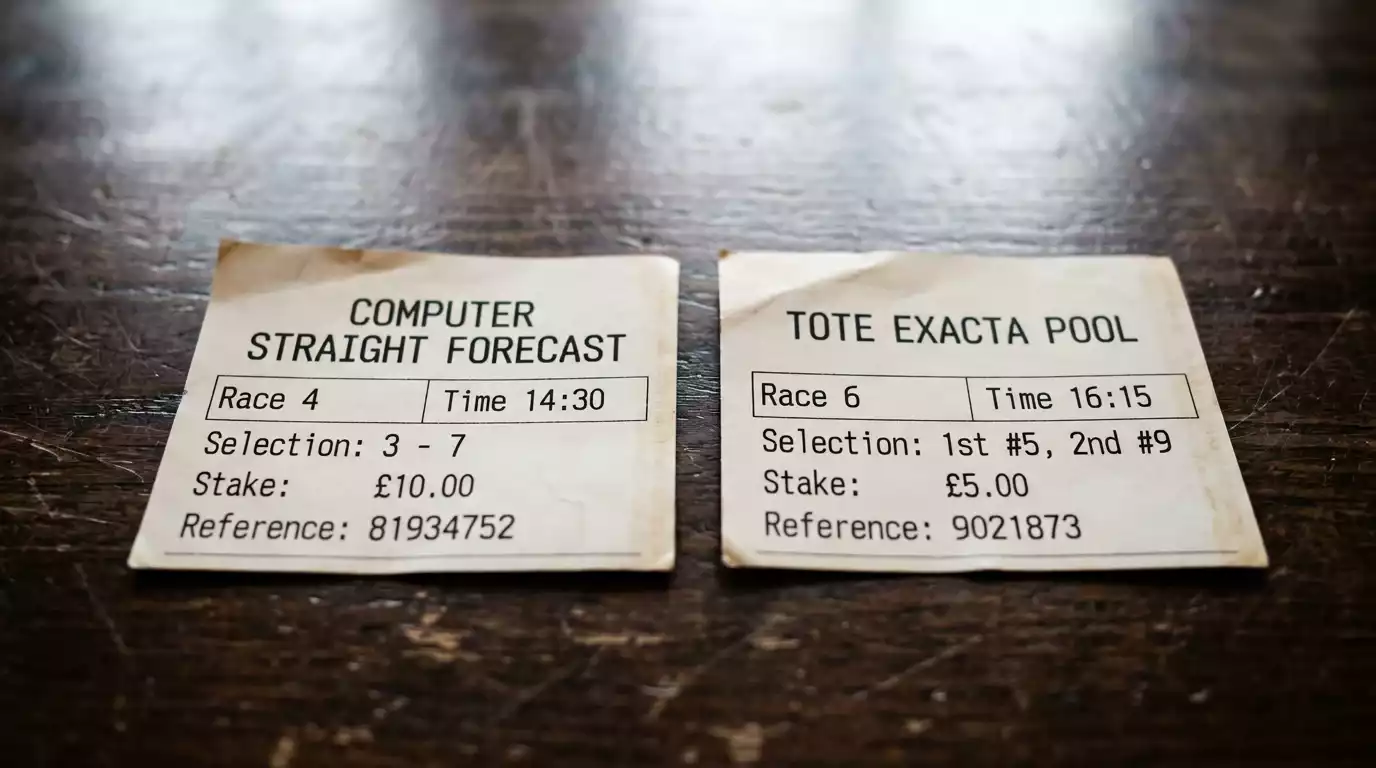
I spent years placing Computer Straight Forecasts without once questioning whether the Tote Exacta on the same race might have paid more. That changed at Newmarket in 2019 when a friend showed me his Exacta dividend slip – same two horses, same finishing order, and his return was nearly double mine. That afternoon rewired how I think about order-dependent exotic bets in UK racing, and the data I have gathered since confirms that my friend’s experience was no fluke.
Both the CSF and the Tote Exacta ask you to predict the first two finishers in exact order. The mechanic is identical. The payout mechanism is not. One is calculated by a formula tied to starting prices; the other is driven by every pound staked into a live pool. That distinction creates genuine, measurable differences in what lands in your account after the weigh-in. This piece breaks down how each system works, where the numbers diverge, and when one consistently outperforms the other.
What a Computer Straight Forecast Is and How It Calculates
A mate of mine once described the CSF as “a spreadsheet pretending to be a bet.” He is not far wrong. The Computer Straight Forecast is a fixed-odds product offered by traditional bookmakers. You pick two horses to finish first and second in the correct order, and the return is calculated after the race using a formula based on the official starting prices of those two horses plus, in most implementations, a weighting for field size and favourite position.
The formula itself is not published in a consumer-friendly way – bookmakers apply it through their settlement systems, and the bettor sees only the final figure. What matters practically is that the CSF payout is deterministic once the SPs are known. It does not depend on how many people backed that particular combination, or how much money sat in a pool. If the winner was 5/1 and the second was 8/1, the CSF return is the same whether ten people or ten thousand people had the same selection.
That predictability is the CSF’s main appeal. You can roughly estimate your return before the off by looking at the current market prices. It also means that CSF payouts are tightly correlated with the fixed-odds market – they inherit whatever biases the SP market carries. In fields where the favourite is very short, the CSF for combinations involving that favourite tends to be compressed. Where a big-priced outsider fills one of the two slots, the CSF stretches, but not always as far as you might expect, because the formula caps certain extreme scenarios.
One structural point worth noting: the CSF is available through almost every licensed UK bookmaker, both online and on-course. You do not need a separate account. It settles alongside your normal bets, and the minimum stake is typically the same as any other fixed-odds wager – often as low as 5p or 10p per line. The convenience is real, and for many casual punters, that convenience is reason enough to stick with it.
How the Tote Exacta Differs in Calculation and Payout
The Tote Exacta looks like the same bet from the punter’s side of the counter. Two horses, exact order, same race. But behind the scenes, it operates on entirely different plumbing. Your stake goes into a pool alongside every other Exacta stake on that race. The Tote deducts its commission – which sits between 16.5% and 19% depending on the product – and the remaining net pool is divided among all winning unit stakes.
This means the Exacta dividend is not known until the pool closes. It is shaped by the total amount wagered, by how many punters backed the winning combination, and by how much “dead money” – stakes on losing combinations – inflated the pool. A combination that attracts heavy public support will pay less than one that only a handful of sharp punters identified. In pool betting, you are not betting against the bookmaker’s margin; you are betting against every other punter in the pool.
That dynamic creates opportunity. When the public overloads one side of a race – piling into the obvious favourite to win with the second favourite in second – the less fashionable combinations quietly accumulate value. The dead money from all those losing tickets gets redistributed to the winners, and because Exacta pools on major meetings can be substantial, the redistribution can be significant.
Placing a Tote Exacta in the UK is straightforward. It is available directly through the Tote’s own platform and also through several bookmakers who offer Tote pool integration. The minimum stake is generally £1 per combination, though permutations allow you to cover multiple combinations from a single entry. If you want the deeper mechanics of how Tote pool betting works across all exotic products, that is covered separately.
Real Payout Comparison: CSF vs Tote Exacta Across UK Meetings
Numbers settle arguments faster than opinions. At Royal Ascot 2025, the World Pool Exacta dividend exceeded the equivalent Computer Straight Forecast in 23 out of 35 races. That is not a marginal edge – it is a two-thirds strike rate across the most high-profile flat meeting in the calendar, with deep liquidity on both sides of the comparison.
The pattern holds beyond Ascot. The Grand National in 2021 produced an Exacta payout of £2,053.30, while the CSF on the same finishing order returned £882.65. That is a gap of over 130%. The race had a massive field, a large pool, and plenty of casual money on popular combinations – exactly the conditions that inflate Exacta dividends relative to their fixed-odds equivalents.
Why does the gap exist? Three factors converge. First, the CSF formula is anchored to starting prices, which already embed the bookmaker’s overround. The Tote pool has its commission too, but the net pool is redistributed entirely to winners – there is no retained margin beyond the stated deduction. Second, exotic pools attract a higher proportion of uninformed money than win markets. Casual punters often box the first three in the betting without deeper analysis, leaving value in less obvious combinations. Third, pool size matters: at major meetings, the sheer volume of stakes creates dividends that can overshoot the SP-derived calculation.
The edge is not universal, though. On quiet Monday afternoons at smaller tracks, Tote Exacta pools can be thin. With limited liquidity, a single large stake can distort the dividend, and the result becomes volatile rather than value-driven. In those scenarios, the CSF’s formula-based stability can actually work in the punter’s favour, delivering a more predictable return.
The takeaway from the data is directional, not absolute. On aggregate, at meetings with reasonable pool depth, the Tote Exacta tends to return more. The advantage is most pronounced in competitive handicaps with large fields and at festival fixtures where casual money floods the pool.
When the Forecast Wins and When the Exacta Pays More
After tracking both products across hundreds of UK races, I have a rough decision framework that serves me well. I default to the Tote Exacta at any meeting where the pool is likely to exceed £15,000-£20,000 on the Exacta product alone – that typically means any Premier or feature meeting, and certainly any festival day. The deeper the pool, the more dead money gets redistributed, and the more likely the dividend exceeds what the CSF formula would produce.
I switch to the CSF in two specific situations. First, on low-profile weekday fixtures where the Exacta pool might be under £5,000 and a single winning ticket could slash the dividend unpredictably. Second, when I am backing a combination involving a very short-priced favourite: the CSF formula treats short favourites reasonably well, and in a thin pool the Exacta dividend for an obvious result can actually dip below the CSF because too many pool participants backed the same combination.
There is also a hybrid approach worth mentioning. Some punters place both – a CSF with their bookmaker and an Exacta through the Tote on the same combination – to see which returns more over a sample of races. It costs double, obviously, but the data it generates is valuable for calibrating your own approach. I did exactly this for three months in 2022, and the Tote Exacta came out ahead in 61% of the races I sampled. Your mileage will vary by the meetings you target, but the structural advantage of the pool mechanism in liquid markets is consistent.
The core principle is simple: the Exacta rewards you for being right in a crowd of people who are wrong. The CSF rewards you for being right regardless of the crowd. Know which environment you are betting into, and choose accordingly.
Is the CSF Forecast available on the Tote or only through bookmakers?
The Computer Straight Forecast is a fixed-odds product settled by bookmakers using an SP-based formula. It is not available through the Tote. The Tote offers the Exacta, which covers the same selection – first and second in order – but pays via pool dividend rather than a calculated formula.
Can you place a reverse Exacta on the Tote?
Yes. A reverse Exacta covers both possible finishing orders of your two selections. It costs twice the unit stake because it generates two separate combinations. If either order lands, you collect the dividend for the winning combination.
Why does the Tote Exacta sometimes pay double the CSF?
The gap widens when the Exacta pool contains a large amount of dead money – stakes on losing combinations that get redistributed to winners. This happens most often in big-field handicaps at major meetings, where casual punters back obvious combinations and leave value in less popular finishing orders. The CSF, tied to starting prices, cannot capture this redistribution effect.
Written by the editors at Exotic Bets Horse Racing.