Superfecta Box Cost: Formulas and Tables for 4 to 8 Selections
 Available in US
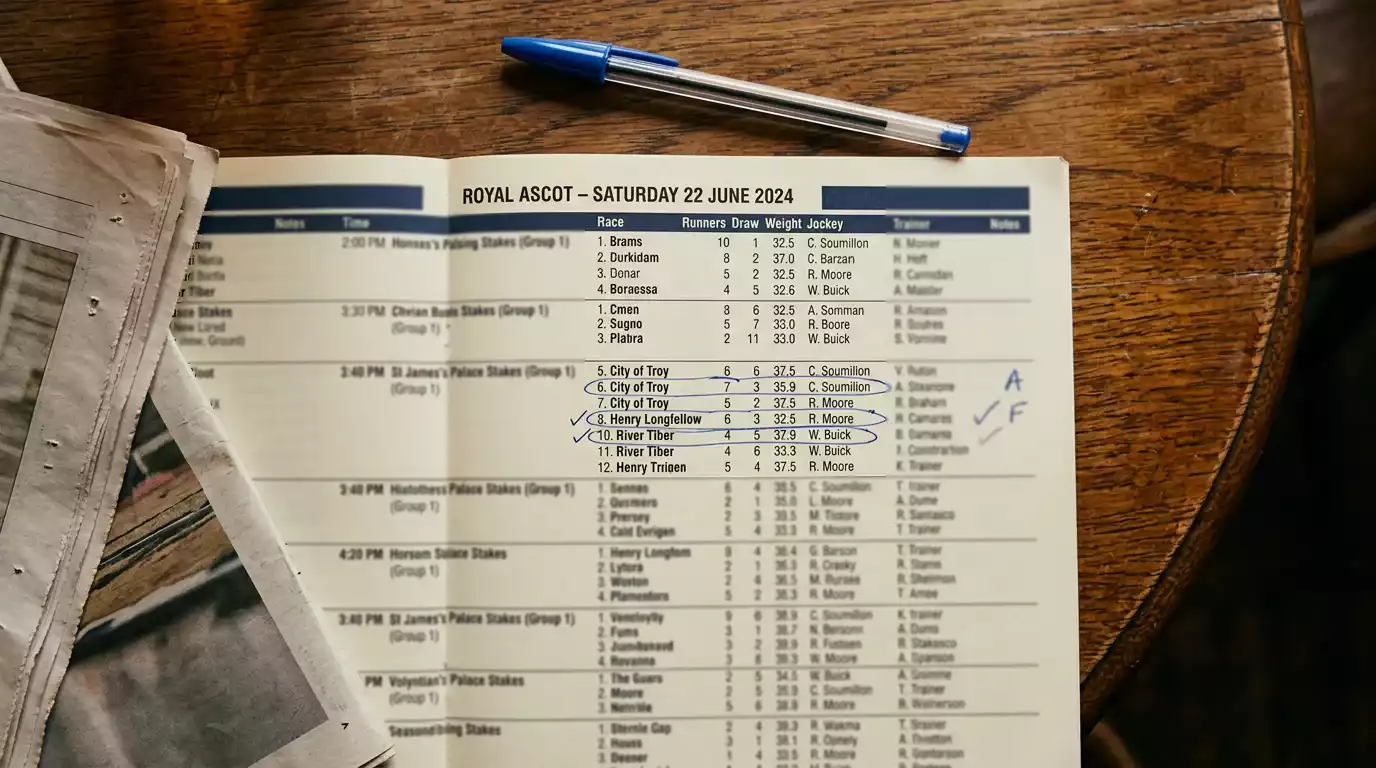
The Superfecta – first, second, third, and fourth in exact order – is the most demanding single-race exotic bet available. It is also the most expensive to box. I learned this the painful way when I casually ticked eight horses on a Tote slip at Ascot, only to watch the cashier quote me a four-figure total for the box. The cost escalation from a Trifecta box to a Superfecta box is not linear; it is exponential in feel, and punters who do not run the numbers before selecting their horses can end up with a bill that no realistic dividend will cover.
The Superfecta Box Formula: n x (n-1) x (n-2) x (n-3)
The formula adds one more factorial term than the Trifecta. Where a Trifecta box is n x (n-1) x (n-2), the Superfecta box is n x (n-1) x (n-2) x (n-3). Each additional horse in your selection adds another multiplier to the chain, and the fourth-position term makes the cost curve steeper than anything in the Exacta or Trifecta.
With four horses – the minimum for a Superfecta – the calculation is 4 x 3 x 2 x 1 = 24 combinations. That costs £24 at a £1 unit stake. Manageable. With five horses, the formula gives 5 x 4 x 3 x 2 = 120 combinations. That is a fivefold increase for adding just one horse. With six horses: 6 x 5 x 4 x 3 = 360 combinations. Seven horses: 7 x 6 x 5 x 4 = 840. Eight horses: 8 x 7 x 6 x 5 = 1,680.
The cost doubles or more with each additional horse past five selections. This is the fundamental constraint of the Superfecta: the bet demands four positions in exact order, and covering every possible arrangement of even a modest group of selections generates a number of combinations that most recreational budgets cannot absorb.
Cost Table: £1 Superfecta Box With 4, 5, 6, 7 and 8 Horses
Here are the numbers that should be on every exotic bettor’s phone before they start selecting horses for a Superfecta:
4 horses: 24 combinations = £24. 5 horses: 120 combinations = £120. 6 horses: 360 combinations = £360. 7 horses: 840 combinations = £840. 8 horses: 1,680 combinations = £1,680.
At a £0.50 unit stake (where available), the figures halve: 4 horses = £12, 5 horses = £60, 6 horses = £180, 7 horses = £420, 8 horses = £840. At a £2 unit stake, they double: 4 horses = £48, 5 horses = £240, and the rest becomes prohibitive for all but the most dedicated pool bettors.
Comparing these to Trifecta box costs on the same number of horses makes the escalation vivid. A five-horse Trifecta box costs £60; the five-horse Superfecta box costs £120 – exactly double, because you are adding one more position to fill. But at six horses, the Trifecta box is £120 while the Superfecta box is £360 – triple. The gap widens further with each additional horse, because the Superfecta’s fourth-position multiplier compounds more aggressively.
These numbers are the reason most serious Superfecta players never box more than five horses. At six horses and above, the cost requires a dividend in the high hundreds or thousands to break even, and while Superfecta dividends can reach those levels in big-field races, the probability of your six selected horses occupying all four top positions is not high enough to justify the outlay in most scenarios.
Partial Superfecta: Keying Horses to Cut Box Costs
The alternative to a full box is a keyed or partial Superfecta, where you fix one or more horses in specific positions and let others rotate through the remaining slots. At Royal Ascot 2025, World Pool exotic dividends consistently exceeded their fixed-odds equivalents – Exacta beat CSF in 23 of 35 races, Trifecta beat Tricast in 24 of 35 – and the Superfecta, where available, follows the same pool-premium pattern. But capturing that premium requires a cost structure that does not absorb the entire dividend.
Key horse A in first, and box four others through second, third, and fourth: 4 x 3 x 2 = 24 combinations. That is the same cost as a four-horse full box but with five horses in play. Key two horses – A in first and B in second – and rotate three others through third and fourth: 3 x 2 = 6 combinations. Key three horses in the top three positions and wheel four others through fourth: 4 combinations.
Each keyed position removes one level of permutation. The savings are proportional to how many positions you can predict with confidence. A two-key Superfecta with three others costs 6 combinations – compared to 120 for a five-horse full box. That is a 95% cost reduction. The risk, of course, is that your keyed horses must finish exactly where you placed them. If horse A finishes second instead of first, every combination loses.
My practical approach: I never fully box a Superfecta. The cost is too high relative to realistic dividends in all but the most extraordinary races. Instead, I use a one-key or two-key structure with the horses I have strongest conviction about locked into their positions and a wider set of contenders filling the remaining slots. The cost stays under £30 in most cases, which is proportional to the dividends I realistically expect.
When a Superfecta Box Is Worth the Investment
The honest answer is: rarely. The Superfecta box is worth the cost only when three conditions align simultaneously. The field must be large enough to generate a significant dead money pool – 14 runners or more, ideally. The race must be competitive enough that the first four finishers are unlikely to be the first four in the betting – a genuine open handicap with form that supports multiple possible top-four configurations. And the pool itself must be deep enough that the dividend rewards the cost of coverage.
Keith Melrose’s observation about pricing errors persisting in exotic pools applies doubly to the Superfecta. The fourth-position prediction adds an extra layer of difficulty that casual punters handle badly – they either ignore the Superfecta entirely or box their shortlist without considering cost. Both behaviours contribute dead money to the pool: the first by reducing competition for the dividend, the second by funding losing combinations that inflate the winning payout.
When I do play a Superfecta, it is at a major Festival meeting on a big-field handicap where I have strong views about the first two positions and a wider net for third and fourth. A two-key structure at £10-£20 total gives me exposure to the dividend without the budget-destroying cost of a full box. The Exacta, Trifecta and Superfecta guide covers the mechanics of all three order-dependent exotics in full.
How much does a Superfecta box with 6 horses cost at a £1 stake?
A six-horse Superfecta box generates 6 x 5 x 4 x 3 = 360 combinations. At £1 per combination, the total cost is £360. This is three times the cost of a six-horse Trifecta box (£120) because the Superfecta adds a fourth finishing position to the permutation.
Is there a minimum Superfecta stake on the UK Tote?
The minimum unit stake for Tote exotic products is typically £1 per combination, though some platforms may offer lower minimums on selected products. At £1 per unit, even a four-horse Superfecta box costs £24, making cost awareness essential before selecting your horses.
How does a partial Superfecta reduce costs compared to a full box?
A partial Superfecta fixes one or more horses in specific finishing positions and only permutates the remaining horses through the open positions. Keying one horse in first and boxing four others through second, third and fourth costs 24 combinations, compared to 120 for a five-horse full box. Each keyed position eliminates one level of permutation, reducing the total cost dramatically.
Written by the editors at Exotic Bets Horse Racing.